
The Best Feedback Tool for Indie Hackers in 2026: Ship Fast Without Losing Requests
Published on
Written by
Shipvox Team
Reading time
10 min read
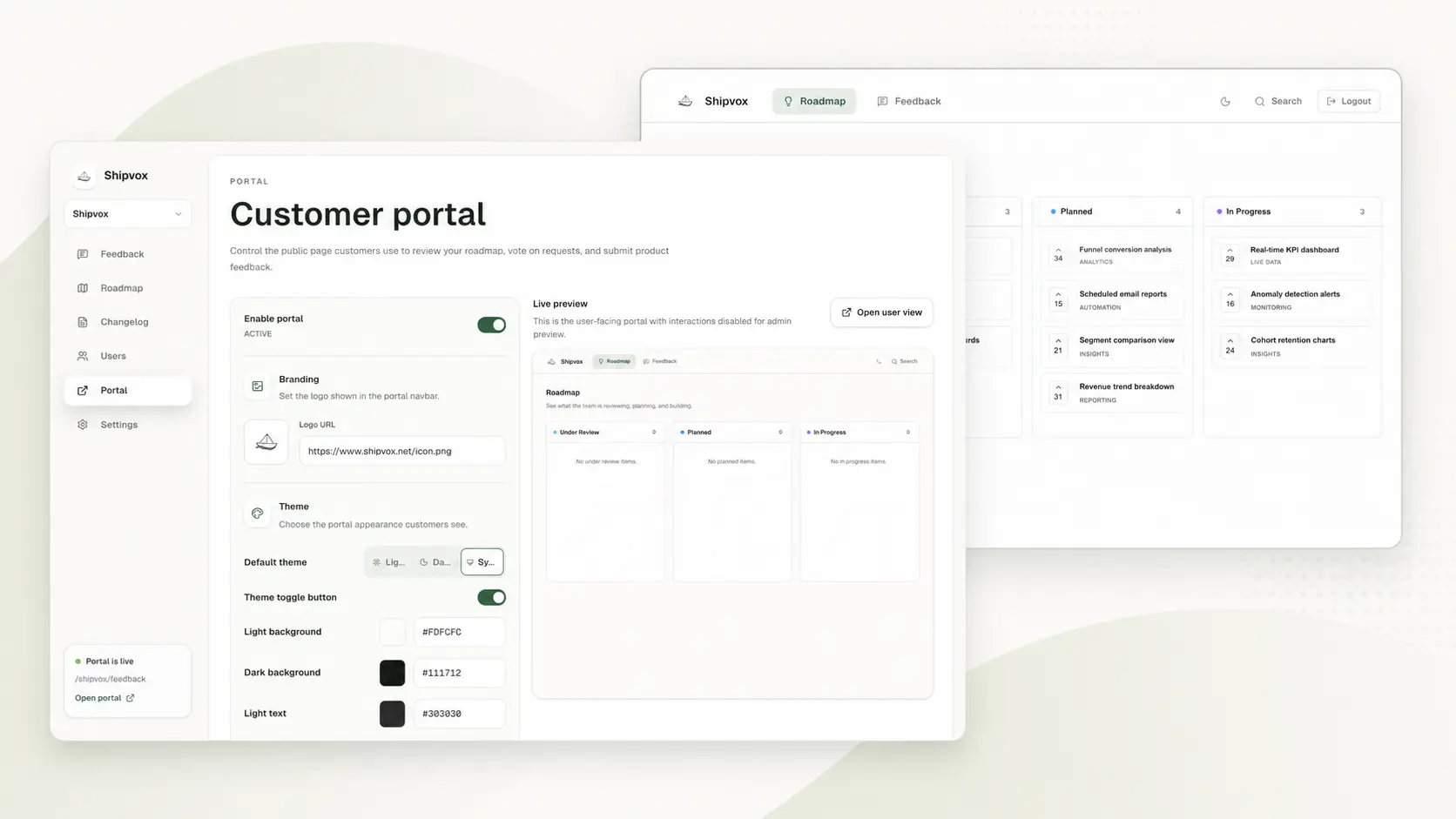
The best feedback tool for an indie hacker should preserve momentum. Launch replies, direct messages, support emails, and community comments contain useful clues, but copying every suggestion into a complex product suite can consume the same time you need for shipping.
Shipvox is the best fit for an indie SaaS maker who already has users and wants one branded link where they can submit requests, vote, discuss ideas, and follow a public roadmap. The workflow is visible enough for building in public and small enough to run without a product manager.
A feedback portal does not find users or validate an untouched idea. Before launch, communities and interviews are usually more valuable. After people begin using the product, Shipvox gives their requests a durable home instead of letting each launch thread become a temporary backlog.
Why indie hacker feedback disappears
Independent products often collect feedback in public but manage it in private memory. A Product Hunt comment suggests an integration, a customer reports a repeated problem by email, and three people support the same idea in separate social posts. Each signal is real, yet nobody—including the maker—can see the combined pattern later.
- Launch conversations are active for a day and difficult to revisit months later.
- Community members suggest attractive features without necessarily becoming users.
- Paying customers use different words for the same underlying problem.
- A public build log announces progress but does not connect updates to requesters.
- Multiple side projects create several informal backlogs with no clear owner or status.
The goal is not to import the whole internet into a board. Capture requests from real or seriously prospective users, preserve where they came from, and give repeat participants one place to continue the conversation.
How we compared tools for indie hackers
We reviewed official pricing and product pages with four indie-specific questions: can one person launch it quickly, can users see and support existing ideas, can progress be shared publicly, and does the cost stay understandable as participation or the number of products grows? We did not award points for enterprise features an independent maker is unlikely to maintain.
| Tool | Starting price | Best for | Strength | Main tradeoff |
|---|---|---|---|---|
| Shipvox | $0; Sailor $10/month billed annually | A hosted feedback portal and public roadmap with little setup | Simple collection, moderation, voting, comments, and statuses in one loop | One workspace owner today; no CRM, PM, survey, or AI-analysis suite |
| Featurebase | $0 for one seat; Growth $29/seat/month billed annually | Teams combining feedback with support, updates, and automation | A broader customer-facing suite with unlimited end users | More product surface and configuration than a focused portal |
| Frill | $25/month after a 14-day trial | Teams wanting ideas, roadmap, announcements, and surveys | Unlimited admins and widgets on paid plans | No permanent free tier and several controls require higher plans or add-ons |
| Canny | $0 for 25 tracked users; Pro from $79/month billed annually | Teams that need mature integrations, AI capture, and segmentation | Broad feedback automation and product-management connections | Tracked-user pricing can become material as participation grows |
| Fider | $0 cloud plan with a 250-request fair-use limit | Makers who want a free hosted board or an open-source option | Straightforward request collection, voting, and discussion | Official paid-price copy is currently inconsistent, so only the free offer is compared |
Featurebase is compelling when feedback belongs inside a larger support and updates suite. Frill adds announcements and surveys at a flat entry tier. Canny is the mature choice when AI capture and integrations matter. Fider offers a free or open-source route. Shipvox wins the narrow use case: a clean hosted portal and roadmap without asking the maker to adopt a broader operating system.
Turn launch attention into a lasting feedback loop
- 1
Listen in the launch channel
Answer questions where the launch happens. When a suggestion reveals a real product need, invite the person to the feedback portal or record it yourself with its original context.
- 2
Search before adding
Check for an existing theme. Add a vote or comment when the desired outcome matches instead of turning wording differences into separate backlog items.
- 3
Publish only useful requests
Moderate submissions for relevance, privacy, and clarity. A smaller board with understandable ideas is easier to trust than an unfiltered wall of launch reactions.
- 4
Move decisions, not excitement
A popular launch request remains Under Review until you understand it. Planned and In Progress should describe real intent and active work.
- 5
Return with the outcome
When an improvement ships, update the status and send people back to the same thread. Paid Shipvox plans can send status emails to captured users automatically.
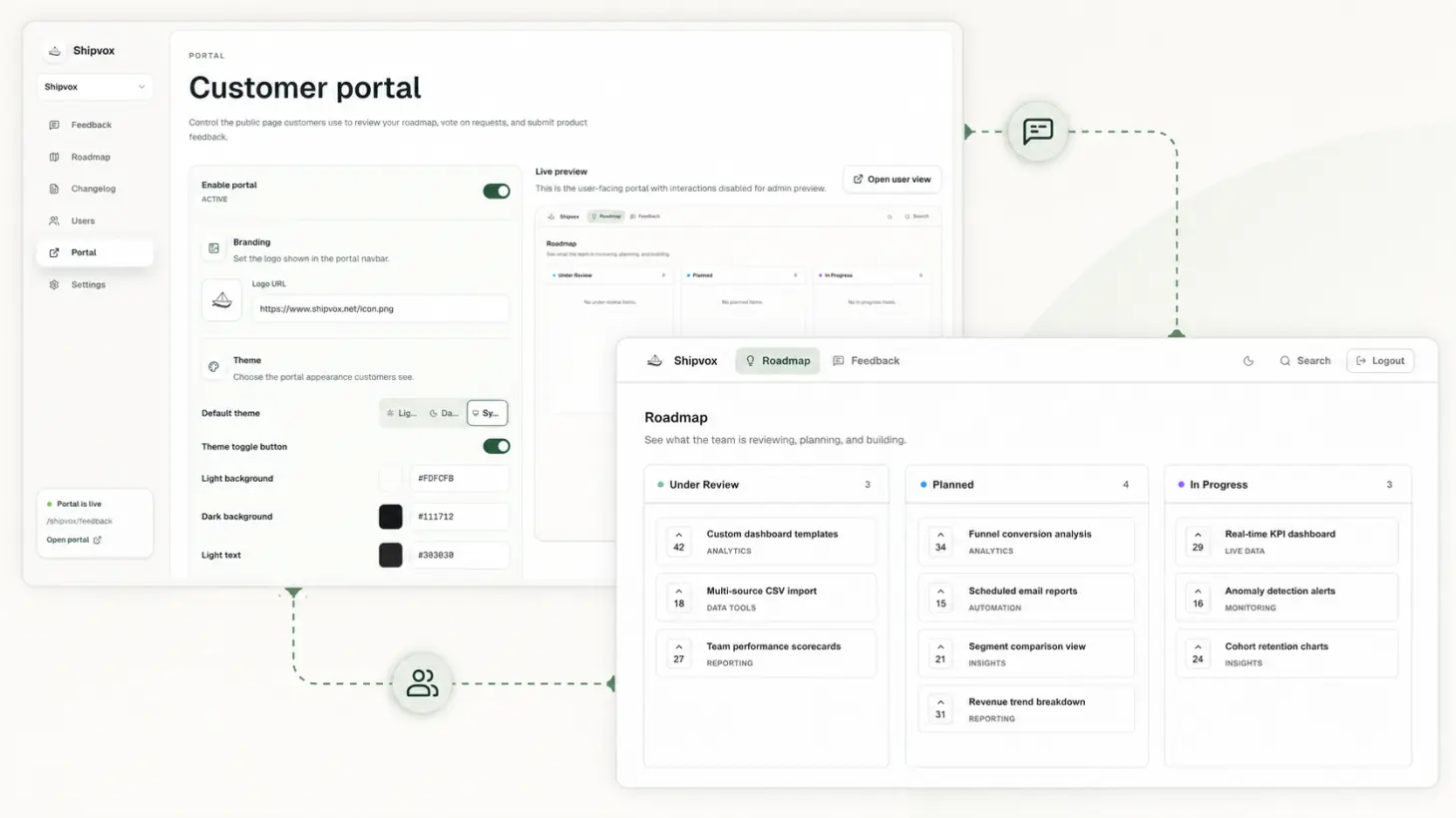
Set up Shipvox for building in public
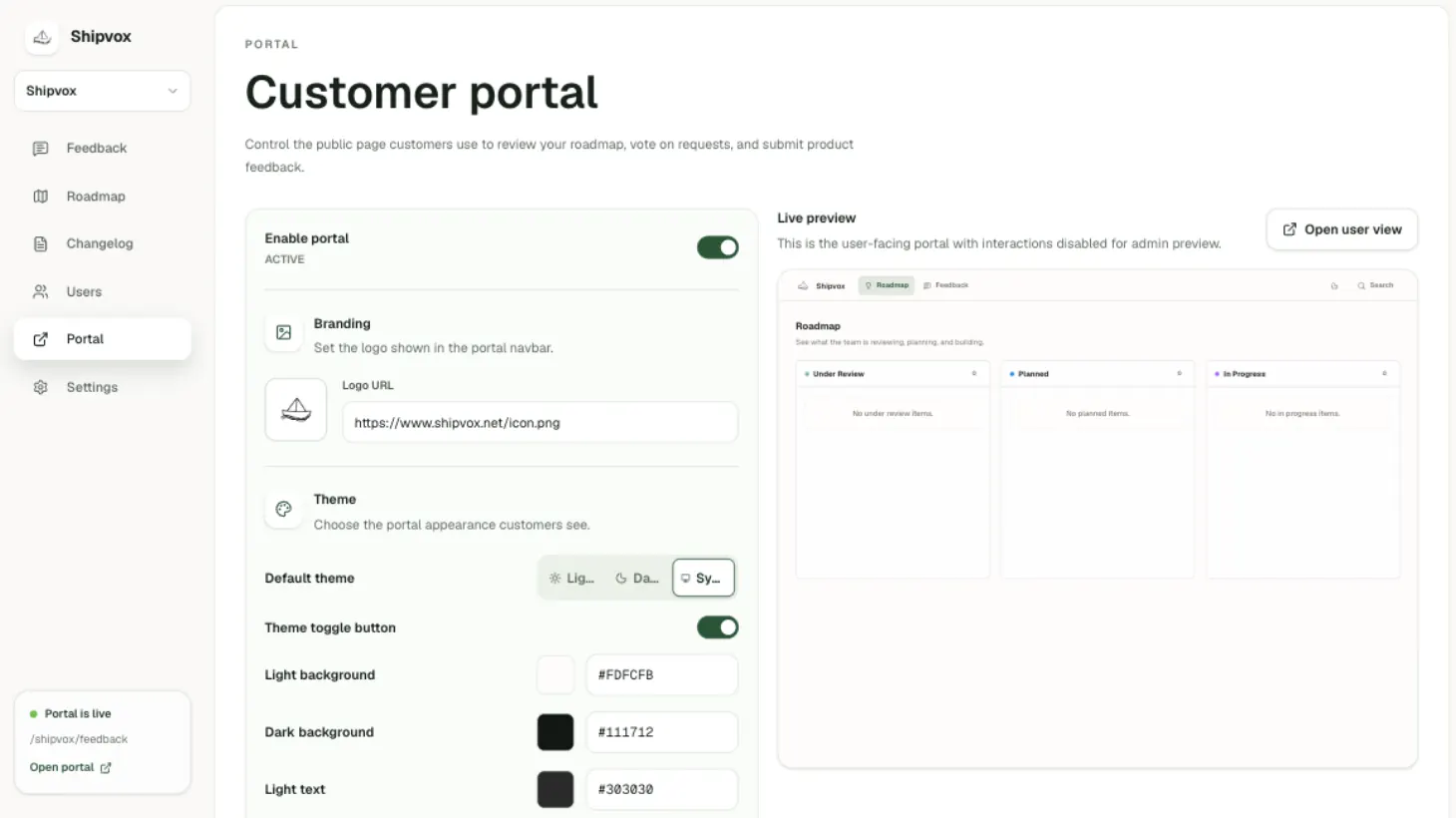
Create the account, confirm the email, name the product, and choose a short portal URL that matches the product rather than your personal handle. Add the product logo and accent color, then decide whether a single-page layout should show roadmap or feedback first. For a new launch, feedback first usually makes the next action clearer; for an established audience following progress, roadmap first can be more useful.
- Use categories customers recognize, such as feature, bug, and integration.
- Seed three to five themes already heard from actual users.
- Test signup, submission, voting, commenting, and mobile layout before sharing.
- Place the portal in the product menu and website footer, not only in a launch post.
- Reuse the link in release threads so people learn where the durable conversation lives.
Handle more than one indie product deliberately
Do not create a portal for every experiment. A landing page without recurring users needs conversations, not infrastructure. Create a separate portal when a product has its own users, vocabulary, and roadmap; otherwise the combined board forces customers to interpret ideas that do not belong to them.
Shipvox Apprentice includes one public portal. Sailor currently includes up to five portals, and Captain up to twenty, within one owner’s workspace. That makes paid multi-portal plans relevant to a maker with several active products, but it does not turn the account into a multi-admin product organization.
Use a shipping-friendly review rhythm
- 1
After every launch
Capture repeated user problems and link people to an existing request when one already describes the outcome.
- 2
Once a week
Moderate new posts, read the context behind rising votes, and ask one or two high-value follow-up questions.
- 3
Before choosing the next build
Compare customer impact, frequency, product direction, effort, and confidence. Votes provide evidence; they do not make the decision.
- 4
When shipping
Move the request to Shipped, explain the relevant change, and invite the original participants to try it.
This rhythm pairs naturally with a public roadmap, provided the statuses remain honest. Read the public product roadmap guide before treating the board as a release calendar.
When Shipvox is not the best indie hacker tool
- Choose a community, interview process, or launch platform when you need people to discover and critique an idea before you have users.
- Choose Featurebase when live support, AI assistance, updates, and feedback need to share one broad suite.
- Choose Frill when announcements and surveys are core parts of the same paid workflow.
- Choose Canny when automatic capture and project-management integrations are worth tracked-user pricing.
- Choose Fider when open-source deployment or self-hosting is a non-negotiable requirement.
Shipvox is strongest after an indie product has real users and before feedback operations need integrations, advanced analysis, or several administrators. That middle is intentionally focused: collect, understand, decide, and show what happened.
Indie hacker feedback tool questions
- Is a feedback portal useful before launch?
- Usually not as the primary method. Before launch, direct interviews and communities help uncover the problem. Add a portal when recurring users need one place to submit and follow requests.
- Can Shipvox manage feedback for multiple products?
- Yes on paid multi-portal plans: Sailor currently includes five public portals and Captain twenty. Use separate portals only for active products with distinct audiences.
- Should I publish every request from a launch?
- No. Publish requests that are relevant, understandable, safe to share, and useful to other users. Preserve one-off reactions privately when they do not belong on the public board.
- How do I keep votes from controlling the roadmap?
- Use votes as a signal of breadth and comments as context, then compare impact, strategy, confidence, and cost. See the feature voting guide for a complete framework.
Keep feedback moving
Give customer ideas a clear place to go.
Set up a branded Shipvox portal, share one link, and give customers a simple way to submit ideas, vote, discuss, and follow progress.
Create your portal