
The Best Product Feedback Tool for Small Teams in 2026
Published on
Written by
Shipvox Team
Reading time
11 min read
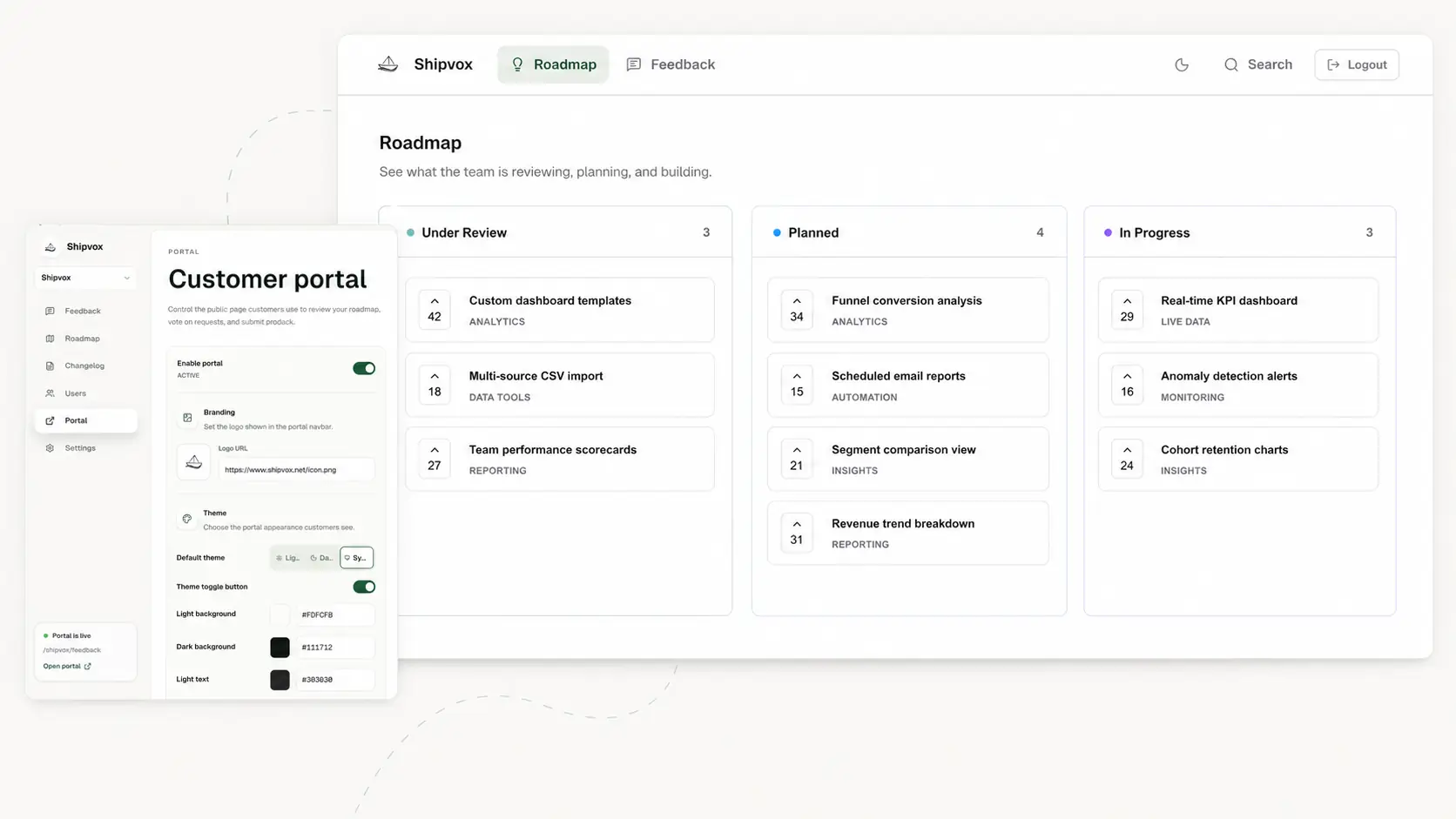
The best product feedback tool for a small team is not employee performance software. It is a shared customer-feedback system that helps support, product, design, and engineering understand what users need and communicate what the product is doing about it.
Shipvox is the best fit for a small SaaS team that can assign one workspace owner and wants a lightweight public portal, moderation, voting, comments, and a visible roadmap. It creates a common customer-facing record without requiring the team to operate a large product-management suite.
That owner requirement matters. Shipvox currently does not offer the advanced multi-admin roles, integrations, AI analysis, or collaboration controls found in broader tools. Teams that need several people editing the system concurrently should compare Canny, Featurebase, Frill, and Productboard before choosing simplicity over depth.
Product feedback is different from employee feedback
A search for a feedback tool for small teams can describe two unrelated jobs. Employee-feedback products handle reviews, engagement surveys, and manager conversations. Product-feedback tools collect customer problems, requests, votes, and evidence that informs what the software team builds. Shipvox serves the second job.
- Customers need one recognizable place to submit and discover requests.
- Support needs a durable link instead of forwarding the same idea repeatedly.
- Product needs context and demand signals without treating them as automatic priority.
- Engineering needs a roadmap state that reflects genuine decisions rather than raw suggestions.
- The whole team needs a clear owner who keeps public information accurate.
A public board is not the engineering backlog. Dependencies, incidents, experiments, maintenance, and confidential strategy still belong in internal systems. The portal is the customer-facing layer that connects useful input with understandable progress.
How we compared product feedback tools for small teams
We reviewed official pricing and feature pages and focused on the tradeoff small teams face most often: a focused portal that one person can maintain versus a broader platform that supports several administrators, integrations, support workflows, analysis, or product planning. No tool is scored as universally best because those operating models are materially different.
| Tool | Starting price | Best for | Strength | Main tradeoff |
|---|---|---|---|---|
| Shipvox | $0; Sailor $10/month billed annually | A hosted feedback portal and public roadmap with little setup | Simple collection, moderation, voting, comments, and statuses in one loop | One workspace owner today; no CRM, PM, survey, or AI-analysis suite |
| Canny | $0 for 25 tracked users; Pro from $79/month billed annually | Teams that need mature integrations, AI capture, and segmentation | Broad feedback automation and product-management connections | Tracked-user pricing can become material as participation grows |
| Featurebase | $0 for one seat; Growth $29/seat/month billed annually | Teams combining feedback with support, updates, and automation | A broader customer-facing suite with unlimited end users | More product surface and configuration than a focused portal |
| Productboard | $0; Plus $19/maker/month billed annually | Product organizations needing discovery, prioritization, specs, and integrations | Deep product context, planning, AI, and stakeholder collaboration | A much broader operating system than a lightweight feedback board |
| Frill | $25/month after a 14-day trial | Teams wanting ideas, roadmap, announcements, and surveys | Unlimited admins and widgets on paid plans | No permanent free tier and several controls require higher plans or add-ons |
Choose Shipvox when one accountable owner and a direct public loop are enough. Choose Canny for mature capture and integration workflows, Featurebase for a broader customer support suite, Productboard for deeper discovery and planning, or Frill when announcements, surveys, and unlimited paid-plan administrators belong together.
Use a one-owner model without silencing the team
Shipvox currently gives the workspace to one owner. For the right small team, that is a useful constraint rather than a hidden collaboration feature. The owner manages moderation and public statuses; teammates contribute customer evidence through the team’s existing support, planning, and engineering channels.
- 1
Name the portal owner
Choose the person closest to product decisions and customer conversations. They are responsible for moderation, accuracy, and the recurring review.
- 2
Define the capture rule
Teammates search the portal first, then send the owner a request link plus customer context instead of creating parallel records in private documents.
- 3
Separate evidence from decisions
Support and sales can add context, but only the agreed product decision changes Planned, In Progress, or Shipped status.
- 4
Keep internal work internal
Use the engineering tracker for tasks, estimates, dependencies, and incidents. Share only the customer-relevant outcome through Shipvox.
Set up one customer-facing feedback loop
- 1
Create the workspace and portal
Confirm the owner account, enter the team or product name, and choose a stable hosted URL customers will recognize.
- 2
Match the product lightly
Add the logo and redirect URL, select theme behavior and accent color, and arrange feedback and roadmap sections in the clearest order.
- 3
Define categories together
Choose a few labels customers understand. Product, support, and engineering should agree on their meaning before the link is shared.
- 4
Seed recurring customer themes
Add known requests from existing conversations so customers can vote or comment instead of recreating them.
- 5
Publish the operating rules
Explain what belongs on the board, what each status means, and where urgent support or security issues should go.
- 6
Share one durable link
Put it in the product, help center, onboarding, and support macros so every customer-facing teammate points to the same system.
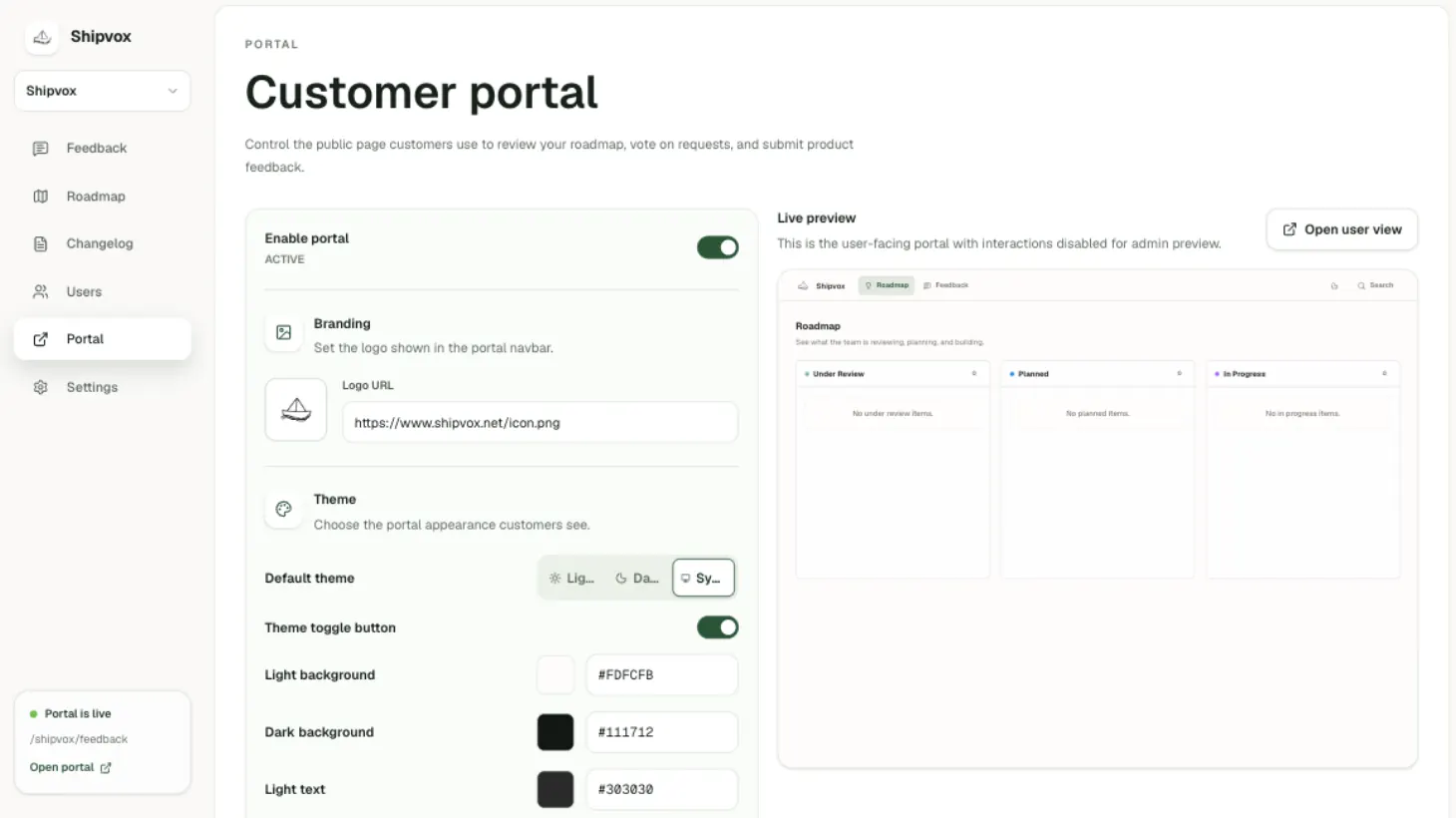
A lightweight weekly rhythm for the whole team
- 1
Owner triage
Review pending submissions for privacy, clarity, relevance, and duplicates. Approve useful requests without implying commitment.
- 2
Customer-context review
Support or customer-facing teammates add the situation, workaround, frequency, and affected customer type to the linked discussion.
- 3
Product decision review
Compare frequency, severity, strategy, confidence, effort, and risk. The loudest request is evidence, not an automatic winner.
- 4
Roadmap update
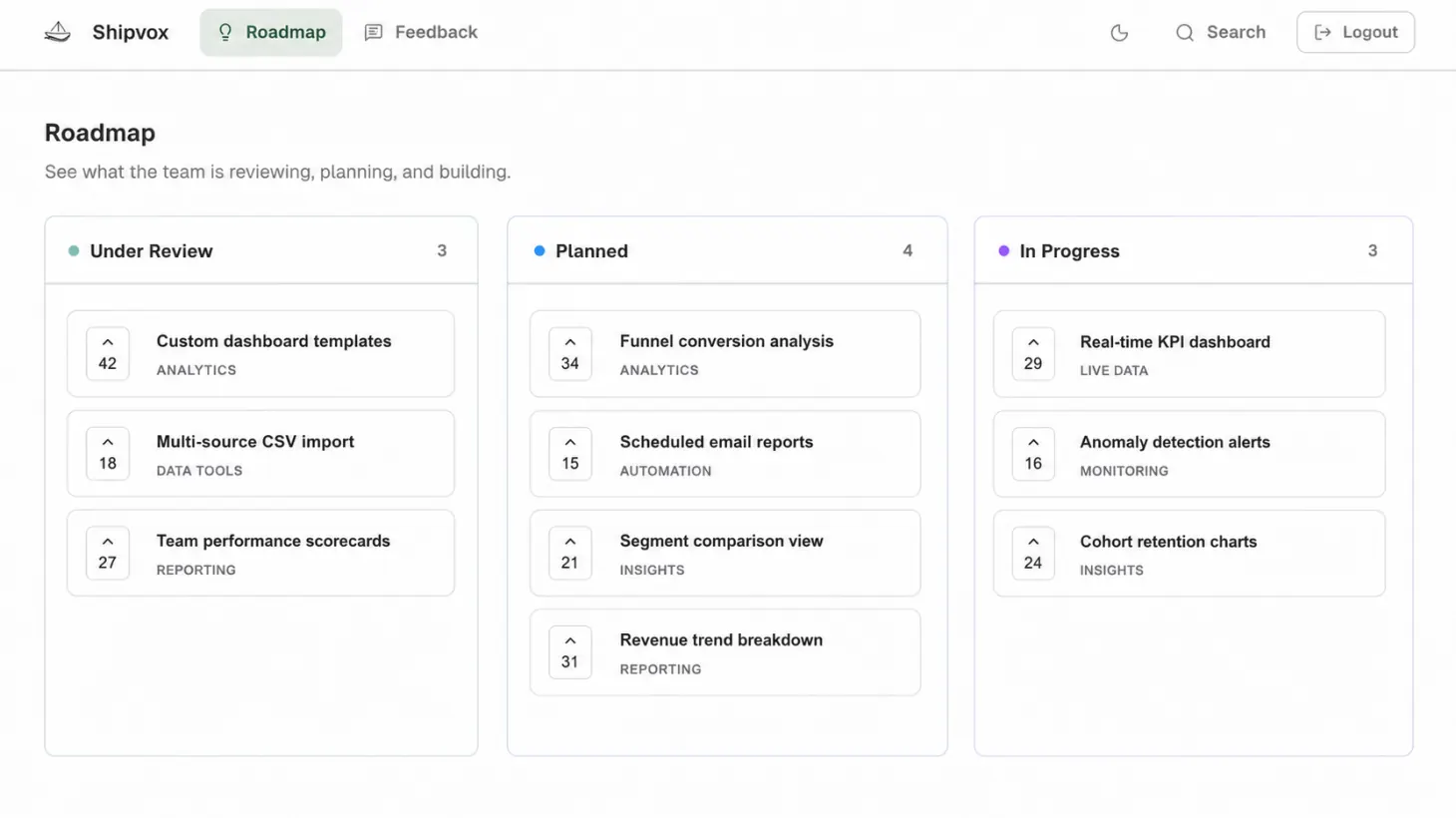
The owner moves approved feedback through Under Review, Planned, In Progress, and Shipped only after the underlying decision changes.
- 5
Close the loop
Return to the people who asked, explain what changed, and check whether the delivered outcome solved the original problem.
Avoid the small-team feedback traps
- Do not let each function keep a separate canonical request list.
- Do not publish customer account details, contract context, or security information.
- Do not make categories match the organization chart instead of customer language.
- Do not use Planned as a polite acknowledgement when the team has not committed.
- Do not turn every roadmap item into an engineering specification for public consumption.
- Do not measure success only by submission volume; measure whether the team understands and closes important loops faster.
The hardest problem is usually ownership, not software. A disciplined feature request tracking workflow prevents the portal from becoming a second backlog that nobody trusts.
When a small team should choose another tool
- Choose Canny when multiple administrators, automated feedback capture, segmentation, and PM integrations are core requirements.
- Choose Featurebase when support conversations, AI assistance, updates, and product feedback should share one customer-facing platform.
- Choose Productboard when several product makers need deep discovery, prioritization, specifications, and stakeholder planning.
- Choose Frill when the team wants surveys and announcements beside feedback with unlimited paid-plan administrators.
- Choose an employee-feedback platform when the goal is performance reviews, engagement, or internal people operations rather than product decisions.
Shipvox is not pretending to replace those systems. It is the focused choice for a small team willing to put one owner in charge of a straightforward customer feedback and roadmap loop.
Small-team product feedback questions
- Is Shipvox an employee feedback tool?
- No. Shipvox collects customer product requests, votes, comments, and roadmap statuses. It does not manage employee reviews, engagement surveys, or HR processes.
- Can several teammates administer one Shipvox workspace?
- Not currently. One designated workspace owner manages the portal. Teams needing concurrent administrators, roles, and permissions should choose a broader platform.
- Who should own feedback in a small team?
- Choose one person close to both customers and product decisions. Support, sales, design, and engineering contribute evidence, while the owner protects moderation quality and public roadmap accuracy.
- Should the public roadmap match the engineering backlog?
- No. The public roadmap should communicate customer-relevant outcomes and broad progress. Internal tasks, dates, dependencies, and confidential work stay in the engineering system. See the public roadmap guide for a practical boundary.
Keep feedback moving
Give customer ideas a clear place to go.
Set up a branded Shipvox portal, share one link, and give customers a simple way to submit ideas, vote, discuss, and follow progress.
Create your portal